Wearables are no longer novelties, they’ve become everyday health companions. Watches, rings, and earbuds now measure sleep quality, stress levels, and cardiovascular patterns with striking accuracy. What comes next may be less about tracking and more about acting: devices that step in at the right moment to help regulate mood and performance. Among the senses, smell stands out as a pathway that is both promising and still surprisingly underexplored.
Smell as a Modulatory Pathway
Smell has a direct line to the limbic system, the part of the brain that shapes both emotion and automatic body responses. Studies have shown how powerful this link can be: lavender often reduces stress, while scents like citrus or mint can improve focus and mental sharpness. Unlike sights or sounds, which we notice and interpret consciously, smells can influence how we feel beneath awareness. That makes them well-suited for interventions delivered in the moment.
The key challenge is knowing when to release a scent. Modern wearables already measure signals such as skin conductance and heart rate variability, both of which track stress and arousal. In controlled research settings, these signals reliably reflect changes in mental state, and consumer devices are now beginning to apply them outside the lab. With the addition of advanced olfactory models, the possibility opens up for systems that not only detect stress but also deliver the specific fragrance most likely to make a difference.
Progress in Miniaturized Scent Delivery
For decades, hardware was the stumbling block. Early olfactory devices were bulky, power-hungry, and confined to research labs or VR installations. That picture is changing fast. Advances in micro-nebulizers, MEMS pumps, and flexible microfluidics are making scent delivery systems faster, smaller, and more energy-efficient. Recent prototypes can release fragrance in milliseconds while running on tiny power budgets making them suitable for continuous, wearable use.
We’re already seeing clips and garment-integrated smart fragrance devices that release calming accords when stress markers rise. These developments suggest a hardware ecosystem that is finally catching up with the science, making personal scent modulation a practical reality.
What This Means for Fragrance and Ambient Scent
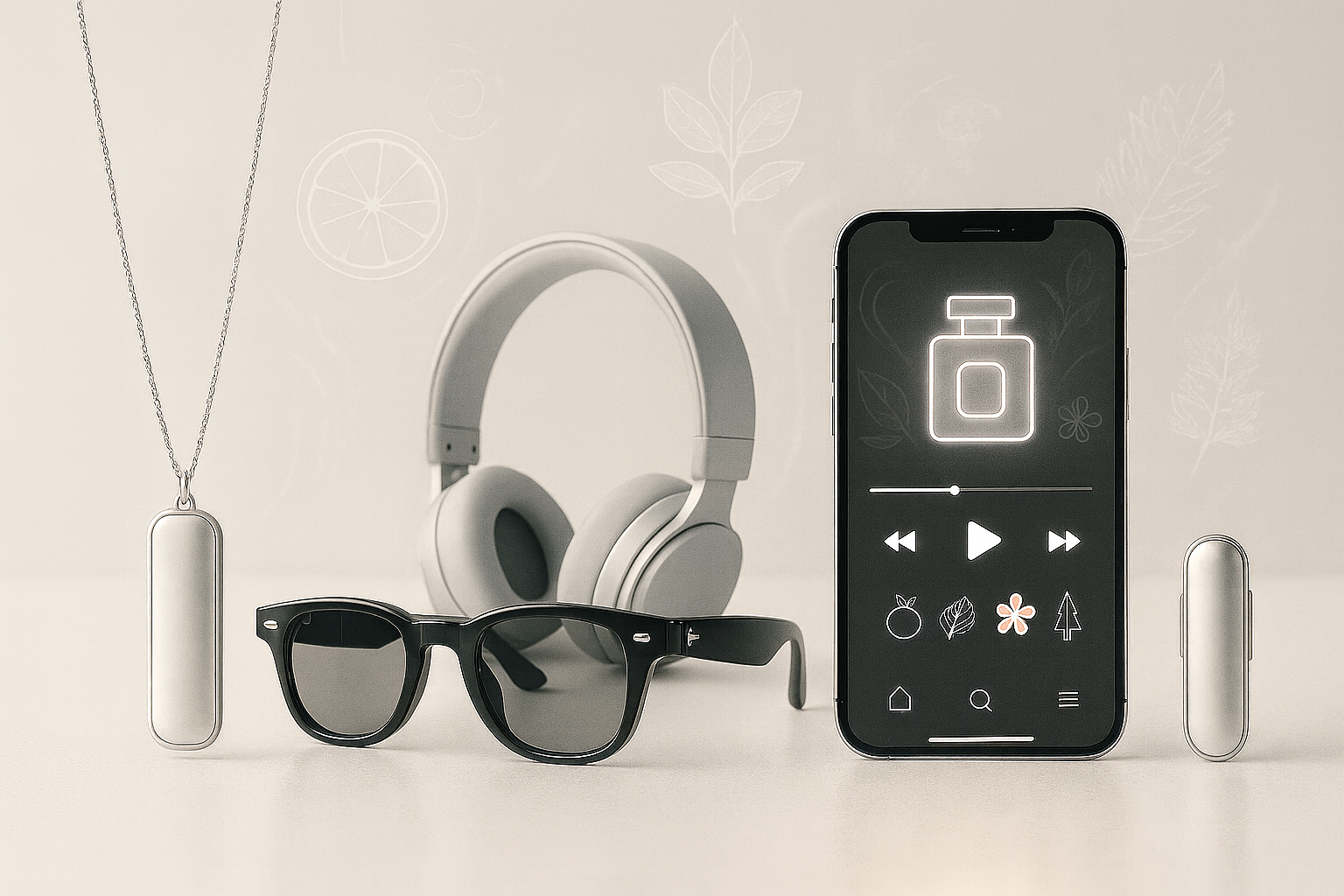
The first consumer products will likely be simple: neckbands or clips that release a small library of calming, focusing, or energizing accords, triggered by biometric signals. More ambitious ideas are emerging too like earphones or textiles that embed scent delivery so fragrance becomes contextual and ambient.
For fragrance houses, this points to a real shift. Instead of static bottles, scent could evolve into adaptive libraries that respond to physiology and daily patterns. New approaches to diffuse fragrance without disrupting the surrounding environment push this even further, offering seamless and personalized scent experiences.
Looking Ahead
The question is no longer whether wearable scent devices are technically possible. They are. The bigger issues lie in regulation, safety, and consumer adoption. Industry standards, such as those from the International Fragrance Association, will guide what can be commercialized. Cultural attitudes will shape whether these devices remain niche or become part of the mainstream wearables ecosystem.
What is clear is that smell is beginning to enter the language of digital health. Just as step counters and sleep trackers became ordinary, olfactory modulation may soon find its way into the everyday loop of data and feedback. For fragrance, this moment is both a scientific test and an opening for entirely new kinds of products.